
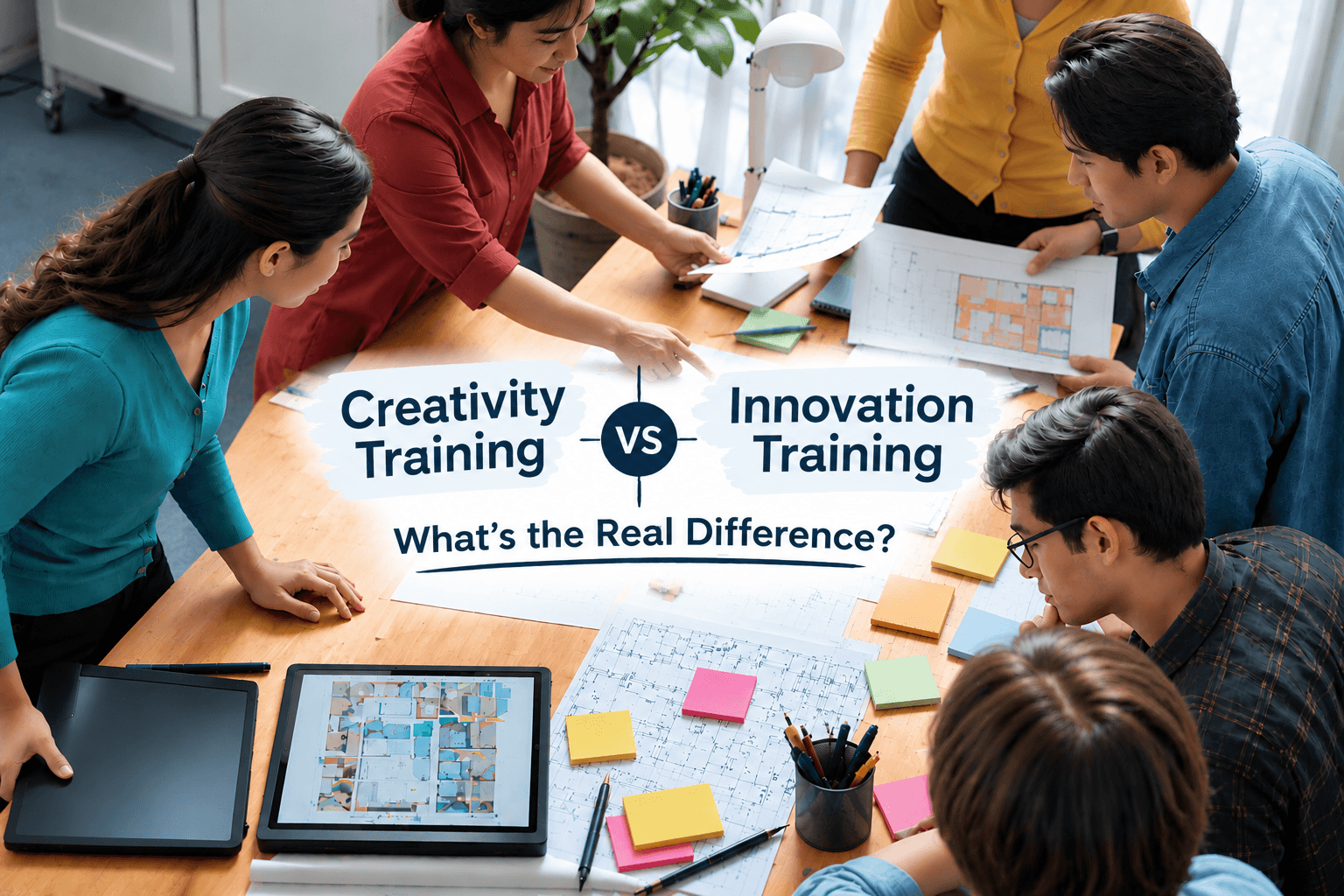
A team can generate dozens of exciting ideas in a workshop and still struggle to create real change. Creativity and innovation often sound like the same skill, but they solve different workplace problems.
For HR and L&D teams, this mix-up can lead to wasted budgets and training that misses the real capability gap. Understanding creativity training vs innovation training helps you choose a programme based on what your people actually need.
Creativity training helps teams develop fresh and useful ideas, while innovation training helps them turn promising ideas into practical results. Knowing where your team gets stuck makes the choice much clearer and gives your training a stronger chance of creating lasting change.
What Is Creativity Training?
Creativity training helps people develop fresh ideas and approach problems from new angles. It gives teams simple methods to move beyond familiar answers and explore different possibilities. In the workplace, the focus is not artistic talent but better thinking and problem-solving.
It can help employees:
- Challenge common assumptions and old ways of working
- Look at problems from different points of view
- Generate a wider range of useful ideas
- Build on ideas shared by other team members
- Find new links between problems, people, and opportunities
- Turn early thoughts into stronger, clearer concepts
As a result, creative capability building gives teams practical skills they can use when familiar solutions are no longer enough.
What Is Innovation Training?
Innovation training assists in turning innovative ideas into actual solutions. Whereas creativity involves the generation of ideas, innovation involves testing and improving the ideas to make them workable. Innovation programmes give workers a framework in which they can convert their ideas into business solutions.
Core Parts of Innovation Training
Teams learning through innovation programmes acquire skills to:
- Test ideas with real users to find out what works before investing more time or money.
- Build quick prototypes to explore how an idea could work in practice.
- Create a simple business case that explains the value, costs, and expected results.
- Pitch ideas to decision-makers and gain support for the next stage.
- Spot risks early so teams can adjust an idea before problems become costly.
Innovation turns creative ideas into useful outcomes. Therefore, when choosing corporate innovation programmes, HR and L&D teams should look for training that gives employees a clear path from idea to testing and implementation.
Creativity Training vs Innovation Training: Side By Side
The easiest way to understand the difference is to look at what each type of training helps your team achieve. Both support growth and better problem-solving, but they focus on different stages of the process.
| Area | Creativity Training | Innovation Training |
| Main goal | Generate fresh and useful ideas | Turn good ideas into practical results |
| Key question | What could we do? | How can we make this work? |
| Main focus | Thinking and idea generation | Testing and implementation |
| Key skills | Brainstorming, problem framing, fresh thinking | Prototyping, testing, planning, pitching |
| Best for | Teams stuck with the same solutions | Teams with ideas that rarely move forward |
| Typical outcome | More varied and useful ideas | Tested ideas, pilots, or action plans |
| Success looks like | Teams approach problems in new ways | Teams move strong ideas towards real use |
So, the choice is not about which training is better. It is about identifying where your team gets stuck and choosing the training that closes that specific gap.
How to Know Which One Your Team Needs
Before choosing a programme, look at where your team faces the biggest challenge. These three questions can help you identify the real skills gap.
1. Does Your Team Struggle to Generate Ideas or Act on Them?
When employees experience difficulties generating new ideas, it makes sense to go for creativity training. However, if employees have good ideas but face difficulty implementing them, then a corporate innovation programme would be ideal for them.
This distinction also helps HR teams decide whether they need focused creative capability building or a programme centred on moving ideas towards action.
2. Is the Main Challenge Mindset or Process?
Mindset barriers can include fear of judgement, fixed thinking, or relying on familiar solutions. Creativity training helps teams challenge these habits and explore new possibilities.
Process problems are different. If employees do not know how to test, develop, or gain support for an idea, a creative innovation programme is more suitable.
3. What Should Change in the Next Six Months?
Define the result you want before choosing the training.
- If you want more fresh and useful ideas, focus on creativity training.
- If you want more ideas tested, developed, or launched, focus on innovation training.
Many teams benefit from both. The key is to start with the capability that is holding people back, then build the next set of skills from there.
Choosing the Right Programme in Singapore
Singapore has many training options, so choosing the right programme can take time. When comparing team training in Singapore, focus on the skills your employees need rather than the programme name alone.
Clear Learning Outcomes
A good programme should state what employees will learn and use at work. Look for clear skills and outcomes instead of broad promises about creativity or innovation.
Practical Workplace Learning
Training should connect with real challenges your employees face each day. Practical activities make it easier for teams to use their new skills after the session.
Support Beyond the Session
Useful training gives employees tools and methods they can continue using at work. This helps turn a one-day learning experience into lasting behaviour change.
Relevant Training Experience
Choose a provider that understands your team’s goals and workplace challenges. A good Creativity Workshop in Singapore should be able to shape the programme around the skills your people need.
Conclusion
Understanding creativity training vs innovation training makes it easier to choose a programme that matches your team’s real needs. People learn to develop original concepts through creativity training while innovation programmes teach them to transform their best ideas into workable solutions.
The right choice depends on where your team gets stuck. The workplace should direct its creative problem-solving approach toward employees who struggle to develop solutions that extend past their current knowledge base. The organisation should implement creativity training because their ideas fail to reach the testing phase and action implementation stage.
Many teams need both skills, but they do not always need them at the same time. Start by identifying the current capability gap, then choose training that gives your people the skills to move forward with confidence.